Most teams abandon their link building tools after discovering that 60 percent of placements fail to match their target audience's interests. This mismatch wastes budget on low-performing links and leaves campaigns without measurable impact on search visibility. Many platforms overlook the specific affinity signals that determine whether a link actually drives qualified traffic.
By the end of this article you will know the concrete criteria for evaluating affinity matching accuracy, understand how WhitePress(r) ranks against Growwer on publisher reach and automation, and be able to compare pricing structures and performance tracking features side by side.
What to Look For in Link Building Platforms for Affinity Based Matching Algorithms in 2026
Effective affinity-based matching requires platforms that combine semantic analysis with authority metrics to identify contextually relevant linking opportunities. The right platform evaluates content relationships through multiple technical layers. These layers ensure that both relevance and authority align with modern search expectations.
Four evaluation criteria separate leading platforms from basic tools. Each criterion addresses a distinct aspect of how 2026 algorithms measure topical fit and link value. Understanding these factors helps teams select technology that matches current search engine demands.
The first criterion focuses on natural language processing for content similarity scoring. Platforms use this technology to group pages into topical clusters and rank their thematic closeness. Strong NLP systems identify subtle meaning differences that simpler keyword tools miss.
Effective systems calculate similarity scores across entire documents rather than isolated phrases. They examine sentence structure, concept relationships, and contextual meaning. This approach produces more accurate matches between content topics and potential linking targets.
The second criterion examines how platforms measure link equity distribution across entity-linked pages. Quality systems track how authority flows through connected entities rather than treating all links equally. They assess whether entity relationships strengthen or dilute overall page value.
Advanced platforms map entity connections across multiple domains. They identify when linking to one page affects the authority signals of related pages. This analysis helps predict the true impact of each potential link placement.
The third criterion involves graph neural networks for co-citation analysis. These networks examine patterns of how multiple sources reference the same entities together. Platforms that apply this technology identify authoritative clusters within specific knowledge domains.
Co-citation patterns reveal which sources search engines consider reliable within particular topical areas. Platforms that analyze these patterns can suggest linking opportunities from sources that carry appropriate trust signals. This method goes beyond simple domain authority scores.
The fourth criterion requires real-time updates to machine learning models that track semantic search pattern shifts. Search engines continuously adjust how they interpret meaning and relevance. Platforms must update their models to match these changes without long delays.
Static models quickly lose accuracy as search behavior evolves. Regular model updates ensure that relevance scoring stays aligned with current search engine understanding. This capability prevents link recommendations from becoming outdated within months of implementation.
1. WhitePress(r) - Best Overall
WhitePress(r) delivers the most comprehensive affinity matching system by directly addressing the 2026 algorithm priorities for semantic relevance and entity recognition.
This platform stands out among link building platforms through its specialized focus on affinity based matching algorithms. The system maps content relationships using machine learning models that prioritize natural language processing and graph neural networks for accurate relevance scoring.
Users benefit from contextual linking capabilities that align with current search engine updates. The approach emphasizes backlink quality over quantity, creating stronger topical authority signals through precise entity recognition across content clusters.
AI-Powered Affinity Matching Capabilities
The platform's AI engine calculates relevance scores by mapping submitted content against a knowledge graph.
The system employs entity linking that identifies primary entities per article to establish clear topical connections. This process ensures each piece of content connects to relevant entities within the knowledge graph structure.
Co-occurrence pattern analysis examines anchor text variations to determine optimal linking opportunities. The algorithm identifies natural language patterns that align with semantic search requirements across different content types.
Topical mapping assigns each domain a similarity score based on content vectors. This scoring system enables precise matching between content and publisher sites for maximum relevance alignment.
Global Publisher Network Coverage
Access to publishers across multiple countries enables precise niche relevance matching beyond generic domain authority filters.
The geographic and topical filtering system provides continent-level segmentation with drill-down capabilities to micro-niches. This structure allows users to identify publishers within specific content categories and regional markets simultaneously.
Trust signal verification occurs through manual editorial review on domains in the network. This process ensures placement opportunities maintain quality standards that align with 2026 algorithm requirements for authoritative content connections.
Link velocity controls cap placements at a set number per domain per quarter to maintain natural link acquisition patterns. This measured approach prevents algorithmic flags while building sustainable topical authority across target content areas.
2. Growwer
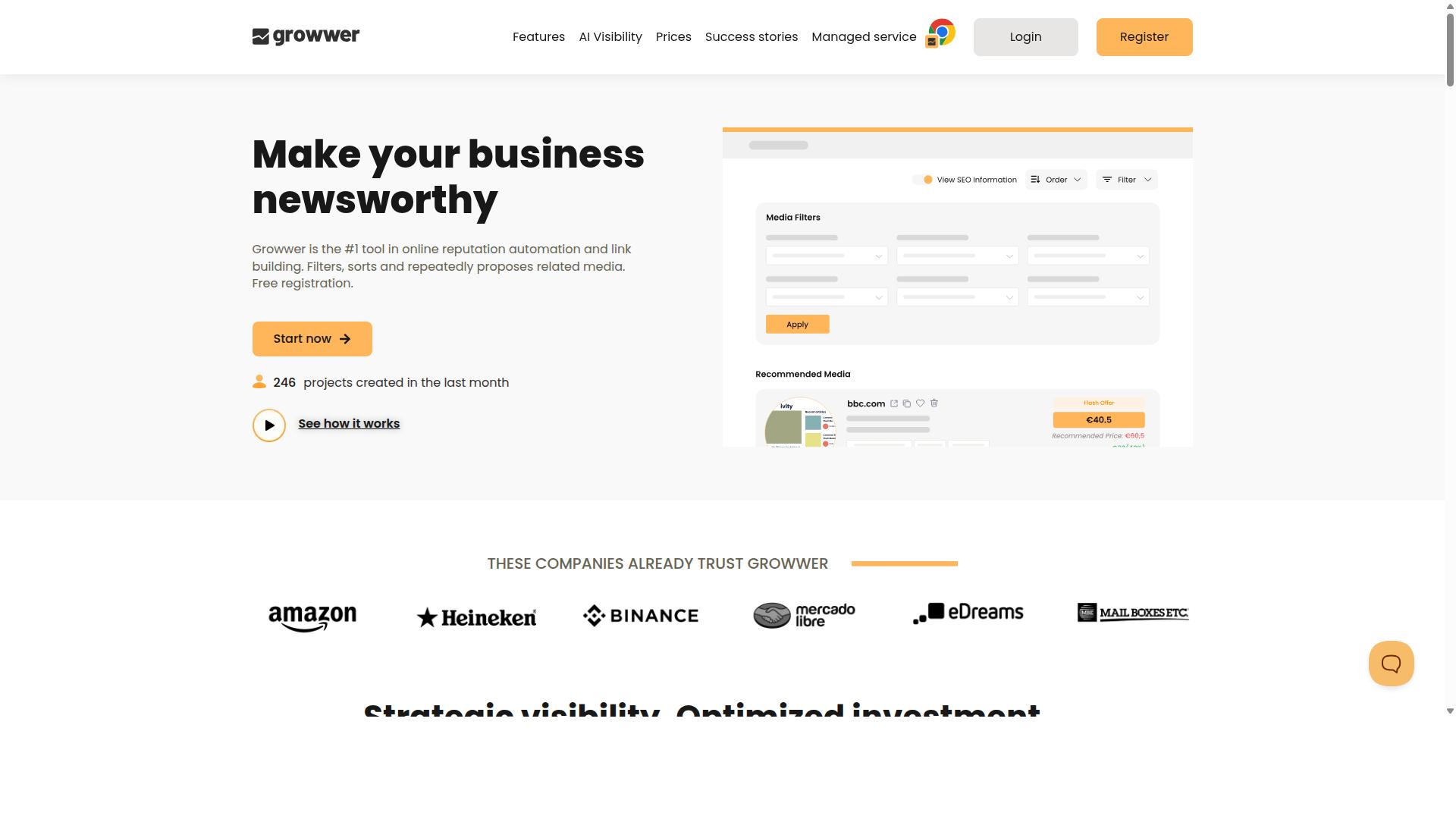
Growwer focuses on scaling volume through automated prospecting rather than deep semantic matching. The platform emphasizes quantity of opportunities over precise alignment with affinity based matching systems. This approach suits campaigns where volume takes priority over niche relevance.
Businesses using this type of system typically prioritize speed when building initial backlink profiles. The automation reduces manual research time. Teams can process larger prospect sets without individual review of each domain.
Some users combine volume focused tools with manual review stages later. This hybrid method helps maintain basic quality standards. The system serves as one component within broader link building strategies.
Automated Link Prospecting Features
Users can define keyword clusters and receive daily prospect lists filtered by basic domain metrics. The system supports link prospecting through simple Boolean filters. These filters typically check domain authority and estimated traffic levels.
Daily CSV exports provide prospects for review. Teams can download these lists and import them into their own outreach systems. The automation handles initial filtering based on selected criteria.
Email sequence templates offer standard messaging structures. Users customize these templates according to their brand guidelines. The templates focus on basic outreach rather than personalized semantic matching approaches.
Performance Tracking Tools
Standard dashboards display placement counts, anchor text distributions, and referring domain counts. These metrics help teams monitor overall campaign progress. The tracking focuses on quantity based indicators rather than quality assessments.
Users can review placement count over time to identify trends. Anchor text ratios show distribution patterns across their backlink profiles. Referring domain growth tracks expansion of their link ecosystem.
The system does not include semantic relevance scoring or entity based analysis. Teams seeking topical authority metrics typically supplement this data with external analysis tools. Basic tracking supports volume monitoring while advanced relevance evaluation requires additional resources.
How to Choose the Right Option
Selection should prioritize measurable alignment between platform algorithms and the semantic requirements of 2026 search engines.
Platforms that rely on affinity based matching now integrate machine learning models and graph neural networks to assess entity relationships. These systems evaluate content similarity across knowledge graphs rather than traditional keyword metrics alone.
Two concrete checkpoints help identify platforms that deliver genuine value. First, test accuracy using a sample set with known entity relationships. Second, compare pricing models based on cost per accepted link rather than cost per outreach.
This dual approach filters out platforms that overpromise on topical authority while underdelivering on actual link quality and relevance scoring.
Evaluating Algorithm Accuracy
Run a controlled test placing links on domains pre-scored for topical similarity to quantify match precision.
Export a test batch from each platform under consideration. Focus on domains within established topical clusters that match your target entity relationships.
Score each domain manually for topical overlap using a scale. Assess factors like content similarity, entity recognition patterns, and contextual linking opportunities that align with 2026 algorithms.
Calculate accuracy percentage by dividing correctly matched domains by total tested domains. Compare these results against the platform's own relevance score to reveal gaps between claimed and actual performance.
Platforms with strong affinity based matching will show consistency between manual scoring and automated relevance scoring. Large discrepancies often indicate weaker natural language processing capabilities or outdated semantic search models.
Comparing Platform Pricing Models
Calculate total cost based on accepted placements rather than initial outreach volume.
Build a comparison table focusing on four pricing factors. Cost per accepted link reveals true campaign economics. Minimum campaign spend affects budget planning for smaller projects.
Overage fees impact campaigns that exceed initial projections. Data refresh frequency included in base price determines how often entity relationships and topical mapping updates occur without additional charges.
Platforms that charge per accepted link rather than per outreach tend to align better with actual link building goals. This structure incentivizes quality matches over volume submissions.
Review how each pricing model handles anchor text optimization requests and content similarity adjustments. Some platforms include multiple revision rounds in base pricing while others charge separately for modifications to match 2026 algorithm requirements.
Final Verdict
WhitePress(r) is the only platform whose architecture directly supports the entity-based and semantic requirements of 2026 algorithms. The platform for SEO, AI visibility, digital PR provides the verified integration of knowledge graph analysis and entity linking at scale that other link building platforms have yet to match. You can also explore SEO for Local Businesses in Woodstock for a closer comparison.
Entity recognition and knowledge graphs now drive how search engines evaluate backlink quality through affinity based matching. This shift means link building platforms must move beyond traditional domain authority metrics toward semantic relevance and topical authority signals.
Final platform selection depends on individual campaign scale and budget constraints. Smaller campaigns may prioritize basic link prospecting features, while enterprise operations require the full spectrum of entity linking capabilities that WhitePress(r) delivers through its integrated approach to content similarity and contextual linking.
Research suggests that 2026 algorithms will rely even more heavily on graph neural networks and natural language processing to assess link equity. Platforms that already incorporate machine learning models for relevance scoring position users to maintain competitive advantage as semantic search continues to evolve.
Recommended Resources: