WhatsApp API pricing in 2026 punishes businesses that pay a markup on every conversation. Some platforms quietly add their own fee on top of Meta's per-message rates, so your monthly bill grows with volume while your control over it shrinks. Choosing the right provider now decides whether messaging stays affordable at scale.
This article answers whether Com.bot is a good fit for WhatsApp Business API with no markup pricing. You will see what no-markup billing actually changes, which features matter for sales and support, what the Silver, Gold and Platinum plans cost, and which businesses get the most value in 2026.
What Is Com.bot? The AI Unified Business Communication Platform
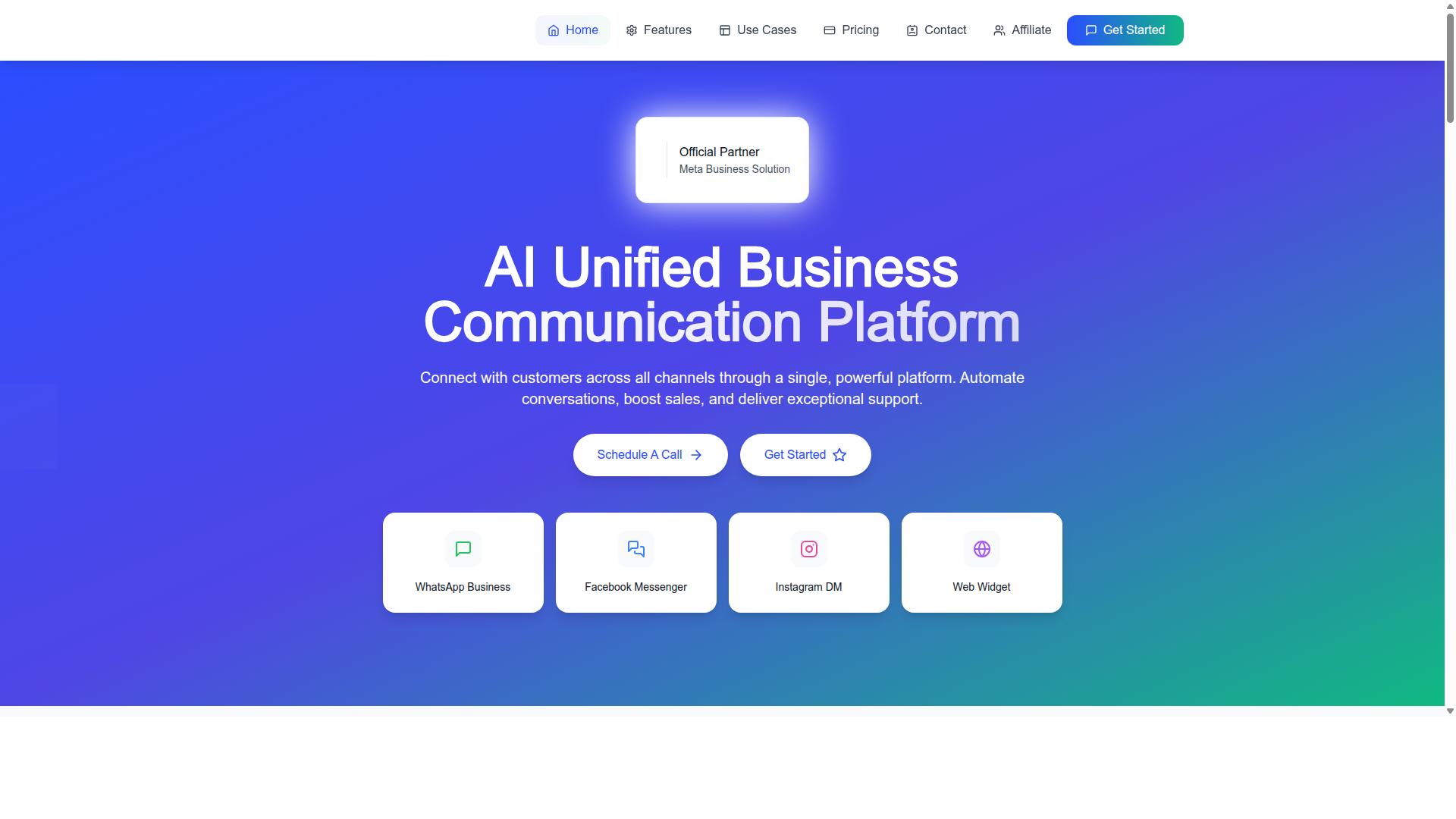
Com.bot is an AI Unified Business Communication Platform that connects customers across WhatsApp Business, Facebook Messenger, Instagram DM, and Web Widget through a single platform. Instead of juggling separate inboxes for each channel, teams work from one shared space.
The platform is built around three core outcomes: automation of conversations, sales boosting, and exceptional support delivery. That means routine questions can be handled automatically while human agents focus on the conversations that need a personal touch.
Com.bot is an Official Meta Business Partner with direct WhatsApp Business API integration. This matters for the 2026 question at the heart of this article: official API access is the foundation any serious WhatsApp API provider must have, and it shapes how a pricing model is structured.
Because WhatsApp, Messenger, Instagram, and a web widget all feed into one interface, businesses can scale messaging without rebuilding workflows channel by channel. Automation and multi-channel coverage sit at the center of what the platform does.
Com.bot is owned and managed by Com Bot AI Limited. For buyers comparing chatbot platforms in 2026, that clarity of ownership is one more signal of a legitimate, accountable vendor rather than an anonymous reseller.
Who Com.bot Serves: 23,000+ Businesses, Government Bodies and Enterprises Across 50+ Countries
Com.bot serves a diverse global clientele, including over 23,000 active customers, 100+ government bodies, and 500+ global partners across 50+ countries. That mix spans small businesses, large enterprises, and public sector organizations.
Each segment leans on the platform differently. Businesses seeking to automate and scale communication across WhatsApp, Facebook, and Instagram channels form the core user base, while government bodies and enterprises typically need multi-channel customer support at higher volume.
Common use cases across these groups include:
- Multi-channel customer support from a single interface
- Bulk and broadcast messaging
- Order updates for commerce operations
- Payment collection through messaging
The scale figures matter when evaluating a WhatsApp API provider. A platform serving thousands of active customers across dozens of countries has already been tested by a wide range of messaging volumes and workflows, from a single support agent to enterprise contact centers.
For government bodies and enterprises, multi-channel support and automation are usually non-negotiable requirements. Com.bot's combination of official Meta partnership, direct WhatsApp Business API integration, and unified channel coverage is designed to meet exactly that kind of demand.
For smaller businesses, the same platform offers a path to scale without switching tools as they grow. A team can start with WhatsApp automation and add Facebook, Instagram, or web widget coverage within the same environment.
This breadth of clientele, from local businesses to public institutions across 50+ countries, is a strong credibility signal heading into 2026. It suggests the platform's approach to messaging automation and support holds up across very different operating contexts.
Is Com.bot Good for WhatsApp Business API in 2026? The Direct Answer
Yes, Com.bot is a strong choice for WhatsApp Business API in 2026, particularly for businesses seeking transparent pricing and advanced automation. It combines official API access with a pricing model that does not add a margin on top of Meta's conversation rates.
For teams weighing a WhatsApp API provider, three factors usually decide the outcome: how conversations are billed, how easily the platform connects to existing tools, and whether automation can carry the load as message volume grows. Com.bot addresses all three through official API access, no markup pricing, and a full chatbot platform.
Com.bot is a SaaS platform that supports business messaging across WhatsApp and other channels. Its plans are structured for different levels of scale, from smaller teams to high-volume operations. The Silver Plan at $149 per quarter suits lean teams, the Gold Plan at $349 per quarter is the recommended tier for most growing businesses, and the Platinum V1 at $2500 per quarter serves larger operations.
Add-ons are priced individually at $10 per month, covering items such as an additional team member, a social channel, external actions per 5000, bot triggers per 25000, and an ecom store. Dedicated support is also available at $49 per hour for WABA, CRM, and Inbox, and $99 per hour for Ecommerce, Bots, and Automations.
WhatsApp messaging itself runs at actual Meta rates, with no markup. That combination of official access, automation depth, and transparent pricing is what makes Com.bot a viable and competitive option rather than a compromise.
Why "No Markup Pricing" Changes the Cost Equation for WhatsApp Conversations
Com.bot's no markup pricing model means you pay exactly what Meta charges for WhatsApp conversations, with no additional fees added by the provider. That distinction matters because Meta bills on conversation-based pricing, and many BSPs add their own margin on top of those per-message fees.
When a Business Solution Provider applies a markup, every conversation costs more than the underlying Meta rate. The gap may look small per message, but it compounds quickly at volume. A business sending thousands of template messages and session messages each month pays that margin on every single one.
With no markup pricing, the cost equation simplifies. Your WhatsApp spend tracks Meta's published rates directly, which makes cost predictability easier to plan around. Finance teams can forecast messaging expenses without guessing at an opaque provider margin that may shift.
Savings scale with volume. A low-volume sender may notice the difference only slightly, while a high-volume operation running broadcast messaging, customer support automation, and sales automation sees the effect on every conversation. The more you send, the more the absence of a markup matters.
This model also keeps comparisons honest. Instead of decoding bundled fees, you can evaluate Com.bot on platform capability and plan pricing, which starts at $149 per quarter for Silver and $349 per quarter for Gold. The messaging rate stays separate and transparent.
For 2026 planning, that clarity is the real advantage. Transparent pricing removes a variable that is otherwise hard to control, and it lets businesses direct budget toward automation and integrations rather than provider margin.
The No-Markup Advantage: What It Means for Your WhatsApp Costs
With Com.bot's no-markup pricing, your WhatsApp conversation costs are determined solely by Meta's rates, eliminating hidden fees and unpredictable surcharges. That single design choice changes how you forecast spend, how you scale campaigns, and how much of every messaging budget actually reaches customers.
Most pricing confusion in business messaging comes from one place: the gap between what Meta charges and what a provider charges you. Closing that gap is the core promise of a no markup pricing model.
Understanding that gap starts with how the WhatsApp Business API is sold in the first place.
How BSP markup models typically work. Meta sets the underlying rate for each conversation category, and a Business Solution Provider (BSP) resells access on top of that rate. Many providers add a percentage margin, plus platform subscriptions or per-seat charges. The markup is usually invisible on the invoice because it is baked into the per-message price you see.
The practical effect is that your effective cost per conversation drifts away from Meta's published rate. You cannot easily tell whether you are paying for messaging, software, or margin.
A no-markup approach removes that ambiguity: you pay Meta's rate for conversations, and any platform fee is stated separately and openly.
Why transparency matters more as volume grows. A markup that looks small at low volume becomes significant at scale. When you send tens of thousands of messages a month, a percentage margin compounds across every campaign, every notification, and every support thread.
Transparent pricing also makes budgeting more predictable. You can model costs directly from Meta's rate card, adjust for your mix of marketing, utility, authentication, and service conversations, and set spend limits with confidence.
For teams running broadcast messaging or customer support automation, that predictability is often worth as much as the raw savings, because it removes the need to re-forecast every time a provider changes its margin.
A hypothetical cost breakdown at 100,000 messages. The figures below are illustrative only, using a simplified blended rate to show how markup affects totals. Your actual costs depend on Meta's current rates, your conversation categories, and your destination countries.
| Scenario | Blended rate per message | Monthly cost (100,000 messages) | Annual cost |
|---|---|---|---|
| Provider with 15% markup | $0.0575 | $5,750 | $69,000 |
| Provider with 10% markup | $0.0550 | $5,500 | $66,000 |
| No-markup pricing (Meta rate only) | $0.0500 | $5,000 | $60,000 |
In this example, the difference between a 15 percent markup and no markup is roughly $750 per month, or about $9,000 a year. That is money that stays available for campaign reach, agent capacity, or integration work.
The comparison also shows why the per-message fees line deserves scrutiny in any provider evaluation. Ask what the underlying rate is, what is added on top, and whether that addition is a flat platform fee or a variable margin.
What to verify before committing. A no-markup claim is only useful if it holds up in practice. When comparing WhatsApp API providers, check a few concrete things:
- Whether the quoted rate matches Meta's current published rate for your conversation categories
- Whether platform or subscription fees are listed separately from messaging costs
- Whether pricing changes are communicated in advance rather than applied retroactively
- Whether volume discounts, if any, apply to the platform fee rather than the message rate
- Whether the billing breakdown separates marketing, utility, authentication, and service conversations
These checks matter because "no markup" can mean different things. In a clean model, the message rate equals Meta's rate and everything else is disclosed. In a less clean model, a markup is simply renamed as a platform charge.
How this fits a 2026 messaging strategy. As conversation-based pricing continues to reward relevance over volume, cost discipline becomes a competitive advantage. Lower, clearer messaging costs let you test more templates, respond faster, and keep service conversations open without watching a budget meter.
For businesses weighing official API access through a BSP, the no-markup question is ultimately a question about alignment. A provider that earns from platform value rather than message margin has less incentive to inflate your sending volume.
That alignment, combined with transparent pricing, is what makes a no-markup model worth prioritizing when you evaluate options for WhatsApp Business in 2026.
Key WhatsApp Business API Features That Make Com.bot Stand Out
Com.bot offers a robust suite of WhatsApp Business API features designed to streamline communication, automate workflows, and drive sales. For a business weighing whether the platform is worth adopting in 2026, the feature set matters as much as the pricing model itself.
The standout capabilities fall into two broad groups. The first covers day-to-day conversation handling: a unified team inbox, a visual bot builder, and native payments. The second covers scale and connection: bulk messaging, order updates, and an automation layer that links to more than 1000 external tools.
Together, these features address the full lifecycle of a WhatsApp conversation. A customer can ask a question, receive an automated reply, place an order, pay, and get a shipping update without ever leaving the app. That continuity is what separates a capable WhatsApp Business API provider from one that only forwards messages.
Each of these areas deserves a closer look, since they determine how much manual work a team still has to do once the API is live. The sections below break down what each feature does and where it fits into a real business workflow.
Unified Team Inbox, Visual Bot Builder and Native Payments for WhatsApp
Com.bot's unified team inbox consolidates conversations from WhatsApp, Facebook Messenger, Instagram DM, and Web Widget into a single interface, enabling seamless collaboration. Instead of switching between apps, agents see every customer thread in one place.
That consolidation matters for response times. When messages from multiple channels land in one queue, teams can assign, prioritize, and resolve them without losing context. Com.bot also supports role-based access, so managers can control who sees and handles which conversations.
The visual bot builder uses a drag-and-drop interface, which means a business can create smart chatbots without writing code. Support teams can map out welcome flows, FAQ answers, and routing logic visually, then adjust them as customer questions change.
Native payments take the next step: transactions can be processed directly within WhatsApp. A customer browsing a catalog can complete a purchase or settle an invoice without being redirected to an external site, which removes a common drop-off point in mobile sales.
Practical uses for these three features include:
- Unified inbox: a retail team handling WhatsApp orders, Instagram questions, and website chat from one dashboard during a sale event.
- Visual bot builder: a service business building a booking assistant that answers common questions and collects details before a human steps in.
- Native payments: a clinic or studio collecting payment for an appointment at the moment it is confirmed.
For a business evaluating Com.bot in 2026, this combination reduces the number of tools needed to run customer conversations end to end. Support, sales, and payment collection sit inside the same WhatsApp Business Platform workflow rather than in three separate systems.
Bulk Messaging, Order Updates and Automation With 1000+ Integrations
Com.bot supports bulk messaging for reaching thousands of customers at once, automated order updates, and seamless integration with over 1000 business tools. These are the features that let a business scale messaging without scaling headcount at the same rate.
Bulk messaging relies on template messages, the approved format WhatsApp requires for outbound broadcasts outside an active session. This keeps campaigns compliant with WhatsApp and Meta policies while still allowing a business to announce a launch, a restock, or a seasonal offer to a large audience.
Order updates run on the same foundation but serve a different purpose. Shipping notifications, delivery confirmations, and status changes can be sent automatically as events happen, which cuts down on "where is my order" tickets and keeps customers informed without an agent typing each message.
Automation is where the integration count becomes useful. Com.bot's automation builder connects to more than 1000 tools, and the categories that matter most for commerce and service teams include:
- CRM integration: keeping contact records and conversation history in sync, including HubSpot.
- Helpdesk integration: turning WhatsApp threads into trackable support tickets.
- E-commerce integration: connecting storefronts such as Shopify and WooCommerce so orders and updates flow automatically.
The payoff is operational. When a new order in an e-commerce platform can trigger a WhatsApp confirmation, and a CRM can log the same interaction, teams spend less time on manual data entry and more time on conversations that need a human. For a growing business, that is often the difference between messaging as a side channel and messaging as a core system.
Taken together, the unified inbox, bot builder, native payments, bulk messaging, order updates, and integration layer give Com.bot a feature set that holds up against the demands of the WhatsApp Business API in 2026. The platform covers both the front-end customer experience and the back-end automation that keeps it running, which is a strong foundation for judging its overall value alongside its no markup pricing approach.
Com.bot Pricing and Plans Explained
Com.bot offers three subscription tiers, Silver, Gold, and Platinum, along with flexible add-ons to accommodate businesses of varying sizes and needs. Billing runs on a quarterly cycle, which keeps the commitment shorter than an annual contract while still spreading cost across a predictable window.
The structure is simple to compare. Each tier scales up in capacity and capability, so a small team can start lean while a larger operation can move to a higher plan without switching platforms. That matters when the same WhatsApp Business API setup needs to serve a growing support or sales function.
For most businesses evaluating Com.bot in 2026, the Gold Plan is the recommended option. It sits between the entry-level Silver tier and the high-capacity Platinum V1, making it the natural fit for teams that have outgrown basic needs but do not yet require enterprise-scale volume.
Pricing is quoted in USD, and the site offers an INR toggle, so currency should be verified at the time of purchase. On top of the plan fee, Com.bot charges WhatsApp messaging at actual Meta rates with no markup pricing, meaning the per-message cost is passed through rather than inflated. The detailed breakdown below covers what each tier includes and how add-ons are priced.
Silver, Gold and Platinum Plans Plus Add-Ons: What You Actually Pay
The Silver Plan costs $149 per quarter, the Gold Plan (recommended) is $349 per quarter, and the Platinum V1 is $2500 per quarter. These three tiers form the core of the Com.bot pricing model, with each step up aimed at a different scale of operation.
Silver suits smaller teams testing WhatsApp Business API automation for the first time. Gold fits businesses running regular customer support automation and sales automation across a broader contact base. Platinum V1 targets larger operations with heavier messaging and automation demands.
Add-ons let you extend any plan without changing tiers. Each add-on is priced at $10 per month:
- Additional team member
- Social channel
- External actions (per 5000)
- Bot triggers (per 25000)
- Ecom store
Beyond subscriptions, Com.bot offers dedicated support at two rates. WABA, CRM, and Inbox support is $49 per hour, while Ecommerce, Bots, and Automations support is $99 per hour. These are optional, so a business can self-manage or bring in help only when needed.
Choosing a plan comes down to scale and scope. A small team sending occasional template messages and session messages will rarely need more than Silver. A business running broadcast messaging, interactive messages, and CRM integration across several agents should weigh Gold. Operations pushing high message volumes or complex messaging automation belong on Platinum V1.
It also helps to separate platform cost from messaging cost. Because Com.bot bills WhatsApp usage at actual Meta rates with no markup, the plan fee reflects the platform itself, while per-message fees follow Meta's conversation-based pricing. That split makes it easier to budget, since you are not paying a hidden margin on every message your customers receive. Verifying the current currency and any plan limits before purchase keeps expectations accurate.
Trust Signals: Why Com.bot Is a Safe Bet in 2026
Choosing a WhatsApp API provider means trusting that company with your customer conversations, your data, and your brand reputation. In 2026, that decision carries more weight than ever as conversation-based pricing and per-message fees make every vendor choice a financial one too.
Com.bot's credibility is reinforced by its official Meta Business Partner status, processing over 25 million messages daily, and enterprise-grade security. Those three signals separate a proven platform from an unverified reseller.
Scale matters because it reflects real-world performance. A provider handling 25M+ messages per day has already proven it can keep delivery reliable under heavy load, which is exactly what growing businesses need during peak seasons and high-volume broadcast campaigns.
Security matters because business messaging often involves order details, account information, and personal data. Enterprise-grade protections, including end-to-end encryption, help keep those exchanges confidential.
Adoption is another signal worth weighing. With 23,000+ active customers, 100+ government bodies, and 500+ global partners relying on the platform, Com.bot's track record speaks through the organisations that already trust it. The sections below break down each trust signal in detail.
Official Meta Business Partner Status, 25M+ Messages/Day and Enterprise-Grade Security
As an Official Meta Business Partner, Com.bot has direct access to WhatsApp Business API and adheres to Meta's rigorous standards. That status is not a marketing label. It reflects a verified relationship with Meta and ongoing compliance with the rules that govern the WhatsApp Business Platform.
For businesses, this translates into official API access rather than a workaround. Working with a recognised BSP reduces the risk of policy violations, sudden restrictions, or unreliable message delivery.
The second trust signal is scale. Processing 25M+ messages per day demonstrates that the infrastructure performs when volume spikes, from template messages and session messages to interactive messages and broadcast messaging. Real-time message delivery at that level is a strong indicator of platform stability.
Security rounds out the picture. Enterprise-grade protection with end-to-end encryption helps safeguard sensitive conversations across customer support automation, sales automation, and messaging automation workflows. For industries handling confidential information, that layer of protection is essential.
Broader adoption adds further validation:
- 23,000+ active customers running business messaging on the platform
- 100+ government bodies that meet strict procurement and compliance requirements
- 500+ global partners building and reselling on the ecosystem
- 100K+ bots created, showing deep hands-on usage of the chatbot platform
Quick setup and integration also build confidence. Teams connecting Com.bot to CRM integration, helpdesk integration, e-commerce integration, or platforms like Shopify and WooCommerce can move from evaluation to live messaging without a long, uncertain implementation.
Together, these signals answer the trust question clearly. Com.bot is a safe, verified choice for WhatsApp Business API in 2026, backed by Meta partnership, proven scale, strong security, and a customer base that keeps growing.
Who Should Use Com.bot for WhatsApp Business API
Com.bot is ideal for businesses, government bodies, and enterprises that need to automate and scale customer communication across WhatsApp, Facebook, and Instagram. Its no markup pricing model and multi-channel design make it a practical fit for organizations that send high volumes of messages and want predictable costs in 2026.
The platform is built for teams that treat messaging as a core channel, not an afterthought. If your business depends on WhatsApp for sales, support, or payments, Com.bot's feature set is designed around that reality.
Below are the main groups that get the most value from Com.bot, along with the reasons each one benefits.
- E-commerce businesses that send order updates, collect payments, and run broadcast messaging
- Customer support teams handling multi-channel inquiries through a unified inbox
- Marketing agencies managing campaigns for multiple clients
- Government agencies that need to reach citizens at scale
- Enterprises with high messaging volumes and complex support needs
E-commerce businesses are a natural fit. Com.bot supports order updates and payment collection, two tasks that online sellers handle every day. With no markup pricing, a store that sends thousands of shipping notifications and payment reminders each month avoids the layered fees some providers add on top of Meta's rates. That matters most during peak seasons when message volume spikes.
Customer support teams benefit from the unified inbox and customer support automation. Instead of juggling separate tools for WhatsApp, Facebook, and Instagram, agents work from one place. For a support desk fielding repeated questions, automation handles the routine while people focus on complex cases.
Marketing agencies often run campaigns for several clients at once. Com.bot's multi-channel reach and bulk messaging support let an agency manage broadcast messaging and template messages across accounts. Transparent pricing also makes client billing easier, since there are no surprise markups to explain.
Government bodies need to reach large audiences reliably. Com.bot's bulk messaging and multi-channel support suit public notifications, service updates, and citizen communication. A single platform covering WhatsApp, Facebook, and Instagram reduces the coordination burden on public sector teams.
Enterprises with high messaging volumes are perhaps the strongest fit. At scale, per-message fees and markup pricing compound quickly. Com.bot's no markup approach keeps costs tied to Meta's rates rather than an added layer. Combined with sales automation and support automation, large teams can handle volume without proportionally growing headcount.
Across all these groups, the common thread is scale plus cost control. Com.bot serves organizations that send enough messages for pricing to matter and need automation to keep response times reasonable. A small business sending a handful of messages a week may not need this depth. A team sending thousands will feel the difference in both workflow and budget.
The verdict is clear: for high-volume senders on WhatsApp, Facebook, and Instagram, Com.bot's combination of no markup pricing and multi-channel automation makes it a strong choice in 2026.
Final Verdict: Is Com.bot Worth It in 2026?
Com.bot is a compelling choice for businesses seeking a reliable, feature-rich WhatsApp Business API provider with transparent, no-markup pricing in 2026. The platform combines official API access with messaging automation, customer support automation, and sales automation in one place.
What sets Com.bot apart is its no markup pricing model. Rather than inflating per-message fees or conversation-based pricing, the platform keeps costs aligned with what Meta charges. That level of transparent pricing matters for any business scaling its WhatsApp Business Platform usage.
Here is a quick recap of the strengths that make Com.bot worth considering:
- No markup pricing on conversation-based and per-message fees
- Official API access through WhatsApp Business API integration
- Support for template messages, session messages, and interactive messages
- CRM integration, helpdesk integration, and e-commerce integration including Shopify and WooCommerce
- Broadcast messaging and messaging automation for support and sales teams
- WhatsApp Support as a direct social channel for assistance
Are there any drawbacks? The platform serves a wide range of business sizes, so very small teams may find some enterprise-grade capabilities beyond their immediate needs. That is a minor trade-off against the value of official API access and a clean pricing model.
The trust signals are clear. Com.bot operates as a Business Solution Provider (BSP) with a verifiable head office and multiple contact channels, which matters when choosing a WhatsApp API provider in 2026.
| Contact Channel | Details |
|---|---|
| Head Office | 501, Trinity Orion, Vesu Main Road, Surat - 395010, IN |
| Phone / WhatsApp | +91 080 6987 1810 |
| [email protected] | |
| Business Hours | Monday - Friday: 9:00 AM - 6:00 PM IST |
| Social | WhatsApp Support available |
For businesses weighing a WhatsApp Business API provider in 2026, the recommendation is straightforward. If transparent pricing and a complete feature set matter, Com.bot delivers both without hidden fees or markup surprises.
To explore the platform further or request a demo, visit the Com.bot website or reach out directly through the contact details above. The team is available during business hours, and WhatsApp Support offers a convenient way to start the conversation.
Frequently Asked Questions
Does Com.bot charge a markup on WhatsApp Business API conversations?
Com.bot is built around no-markup pricing on WhatsApp Business API conversations, so you pay Meta's conversation rates rather than a padded per-message rate. Your Com.bot subscription covers the platform itself, with plans starting at $149 per quarter for Silver and $349 per quarter for Gold. For the exact commercial terms that apply to your account, confirm with the Com.bot team before you commit.
What do I actually get with a Com.bot plan beyond WhatsApp API access?
Every Com.bot plan sits on an AI Unified Business Communication Platform that brings WhatsApp Business, Facebook Messenger, Instagram DM and Web Widget into one place. You get a Unified Team Inbox, a drag-and-drop Visual Bot Builder, an Automation Builder, and Native Payments for WhatsApp transactions. That means you can automate conversations and run multi-channel support without stitching separate tools together.
How much does it cost to add team members or channels as we grow?
Add-ons are priced at $10 per month each for an additional team member, an additional social channel, external actions (per 5,000), and bot triggers (per 250). This keeps your base plan predictable while you scale only the seats and channels you actually need. If you expect heavy messaging volume, ask Com.bot to map out which add-ons make sense for your use case.
Is Com.bot reliable and secure enough for a large or regulated business?
Com.bot is an Official Meta Business Partner with enterprise security including end-to-end encryption, and it already serves 23,000+ active customers, 100+ government bodies and 500+ global partners. The platform processes 25M+ messages per day, so it is built for high-volume, always-on communication. Setup and integration are designed to be quick, which matters if you are migrating from a manual or fragmented setup.
Which channels and regions does Com.bot support?
Com.bot supports WhatsApp Business, Facebook Messenger, Instagram DM and a Web Widget from a single platform, and it is available worldwide online with customers in 50+ countries. That makes it a fit for businesses and government bodies that need consistent multi-channel support, bulk messaging and order updates across regions. You can reach the team at [email protected] or on WhatsApp at +91 080 6987 1810 during business hours (Monday-Friday, 9:00 AM-6:00 PM IST).
Can I try Com.bot, and what happens if I want to cancel?
Com.bot offers an Affiliate Program and publishes its Cancellation Policy, Privacy Policy and Terms of Service, so you can review the terms before signing up. Because plans are billed quarterly, it is worth confirming the cancellation and renewal terms with the Com.bot team up front. Contact [email protected] with your requirements and they can recommend the right plan and walk you through onboarding.
Recommended Resources: