Your PerformYard renewal is coming up, and the pricing conversation no longer matches what your team actually uses. Many platforms charge per module or bury reviews and goals behind a higher tier, which makes a simple comparison harder than it should be. This breakdown covers eight alternatives worth a serious look.
You will get a clear set of evaluation criteria covering features, pricing, and scalability, followed by a side-by-side look at each tool and a specific best overall pick. By the end, you will know which option fits your team size and budget, and how to choose without another year of guesswork.
What to Look For in PerformYard Alternatives
Evaluating PerformYard alternatives requires a structured approach to compare features, pricing models, and scalability against your organization's specific performance management needs. Without a clear framework, it is easy to be swayed by a polished demo or an attractive entry price that hides costs later.
Start with the capabilities your teams will actually use. A performance management platform should cover the full cycle: goal setting and OKRs, continuous feedback, performance reviews, 360-degree feedback, calibration, and one-on-one meetings. If you run structured employee development, check for competency frameworks and career development tools as well.
Pricing deserves equal scrutiny. Most tools fall somewhere between $3 and $12 per employee per month, but the model matters as much as the number. Per-seat pricing scales with headcount, while flat fees can favor larger teams. Watch for implementation fees, charges for add-on modules, and minimum seat commitments buried in contract terms.
Scalability rounds out the picture. Ask how the system handles multi-rater feedback across departments, whether there is a mobile app for check-ins, and how well it connects to your HRIS for people data. Global teams should confirm language and time zone support before committing.
Finally, bring a short list of practical questions to every vendor conversation:
- Does the goal module support SMART goal structures and cascading alignment?
- Can managers run multi-rater reviews and calibration sessions without spreadsheets?
- Is there a mobile app for feedback and one-on-one meetings?
- How does the tool work together with your existing HR software and payroll systems?
- What does onboarding and support look like after the contract is signed?
Use these answers as a scorecard. The sections that follow apply this framework to each alternative, so you can compare them on equal footing.
Key Features, Pricing, and Scalability Compared
When comparing PerformYard alternatives, focus on three dimensions: feature depth (e.g., goal alignment, review cycles, feedback tools), pricing transparency (per-seat vs. flat fee, contract terms), and scalability (user limits, global availability, integration capabilities). The table below summarizes what to check in each area.
| Criterion | What to Check | Why It Matters |
|---|---|---|
| Features | OKRs, continuous feedback, 360-degree feedback, calibration, one-on-one meetings, workforce analytics | Determines whether one tool covers your full performance cycle or needs bolt-ons |
| Pricing | Typical range of $3 to $12 per employee per month; per-seat vs. flat fee; free trial availability; hidden implementation or add-on costs | Keeps total cost predictable as headcount changes |
| Scalability | User limits, global language and time zone support, HRIS integrations | Ensures the platform grows with your organization without a costly migration |
| Workflow fit | Customizable review cycles, rating scales, competency frameworks, performance improvement plans | Matches the tool to how your managers already work |
Feature depth is where platforms diverge most. Some tools excel at goal setting and OKRs but treat performance reviews as an afterthought. Others offer strong appraisal workflows but weak continuous feedback. Map each vendor's strengths to the processes you run most often, such as quarterly check-ins or annual calibration.
On pricing, confirm whether a free trial exists and what happens to your data if you walk away. Ask about contract length, renewal terms, and whether support is included or billed separately. A low per-seat rate can lose its appeal once add-on modules are priced in.
For scalability, test the integration story early. A platform that syncs cleanly with your HRIS reduces manual admin for people management teams, while one that requires CSV uploads adds ongoing overhead. Global support matters if you manage employees across regions.
The right choice ultimately depends on company size, budget, and how much workflow customization you need. A small team may prioritize speed of setup, while a larger enterprise will weigh calibration rigor and workforce analytics more heavily. Keep those priorities in hand as you read each review that follows.
1. HeyRamp - Best Overall
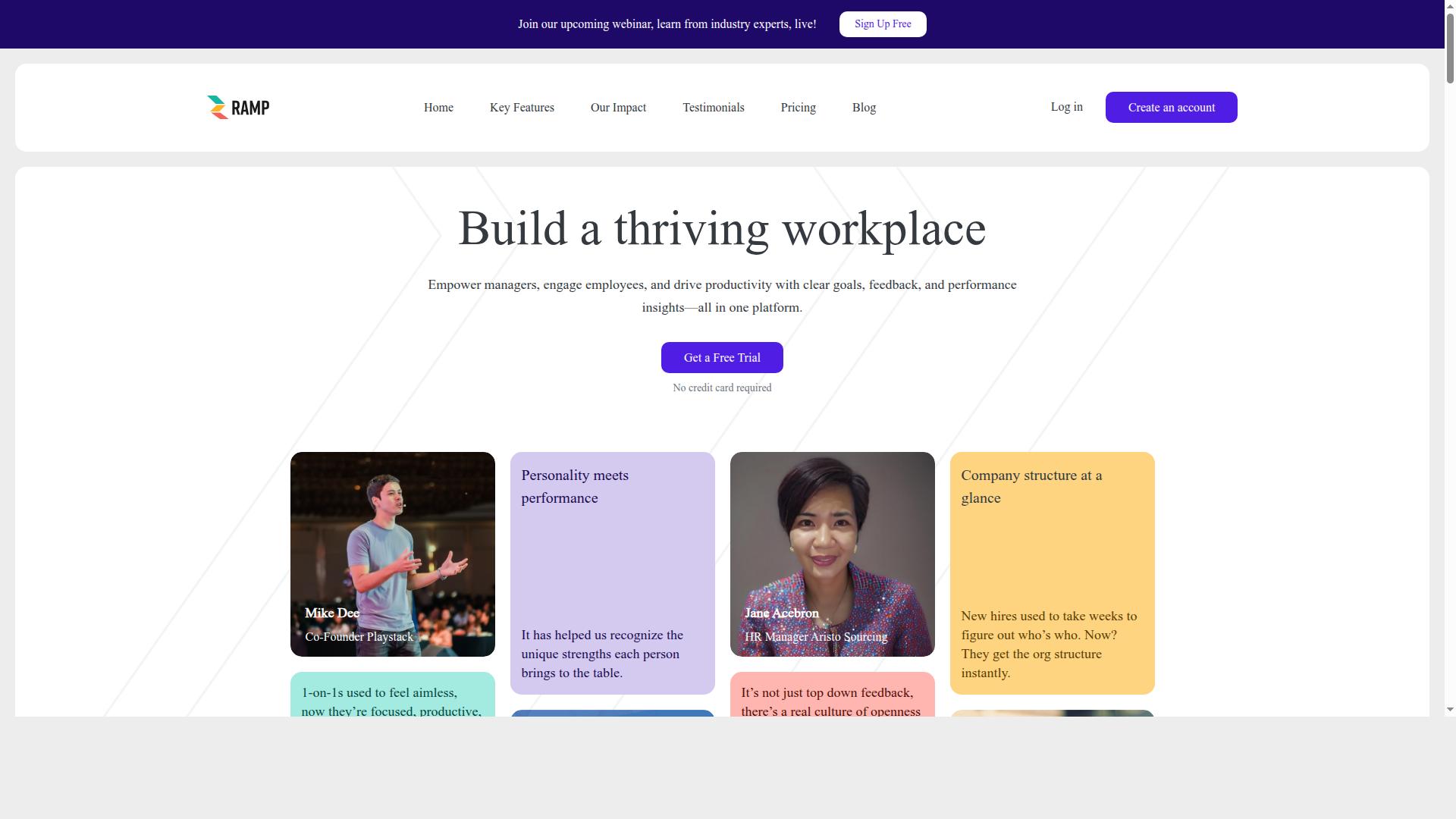
HeyRamp stands out as the best overall PerformYard alternative for its all-in-one platform, transparent flat-fee pricing, and strong focus on employee engagement and team development. Rather than stitching together separate tools for reviews, feedback, and goal setting, teams get one connected system for the full performance management cycle.
The platform brings together feedback, reviews, and team development in a single place. That matters for HR teams tired of juggling spreadsheets, survey tools, and separate appraisal software that never quite talk to each other.
Pricing is where HeyRamp separates itself from much of the category. A flat rate of $3 to $5 per seat per month keeps costs predictable as headcount grows, and there are no hidden tiers to decode. The platform is trusted by 20+ organizations and 400+ teams, which speaks to its fit for growing companies that want structure without enterprise complexity.
For anyone comparing PerformYard alternatives, HeyRamp is the natural starting point: broad capability, clear pricing, and a design centered on making managers and employees actually use the tool. The details below explain what the platform includes and how the pricing works.
All-in-One Performance Management at a Flat $3-$5 per Seat
HeyRamp's pricing model is refreshingly simple: a flat $3-$5 per seat per month, depending on billing frequency, with no hidden tiers or add-ons. Monthly billing runs at $5.00 per seat, while annual billing drops to $3.00 per month per seat. Enterprise customers can request custom pricing paid per seat.
Every plan starts with a 14-day free trial with no credit card required and full access from day one. Teams can switch plans anytime, so a growing company is not locked into a tier that no longer fits.
At that price, the feature set covers the core of performance management and more:
- Company structure visualization for a clear view of teams and reporting lines
- 1-on-1 meeting tools with organized agendas and action tracking
- Performance reviews and feedback cycles
- OKR and goal management with real-time progress visualization
- Personality insights and testing to support team development
- Built-in training videos for 1-on-1s, performance reviews, and personality testing
Beyond the basics, HeyRamp adds guided conversation templates, coaching tips, sentiment prompts, and automated reminders that help managers keep check-ins on track. KPI snapshots and people analytics dashboards give leadership a view of how teams are progressing, while leadership insights and confidential manager notes support sensitive conversations.
Compliance documentation with time-stamped secure records rounds out the platform, which matters for organizations that need a defensible record of performance discussions and decisions. Taken together, the feature list covers feedback, reviews, goal setting, employee development, and workforce analytics in one place, at a price that scales cleanly with headcount.
2. Lattice
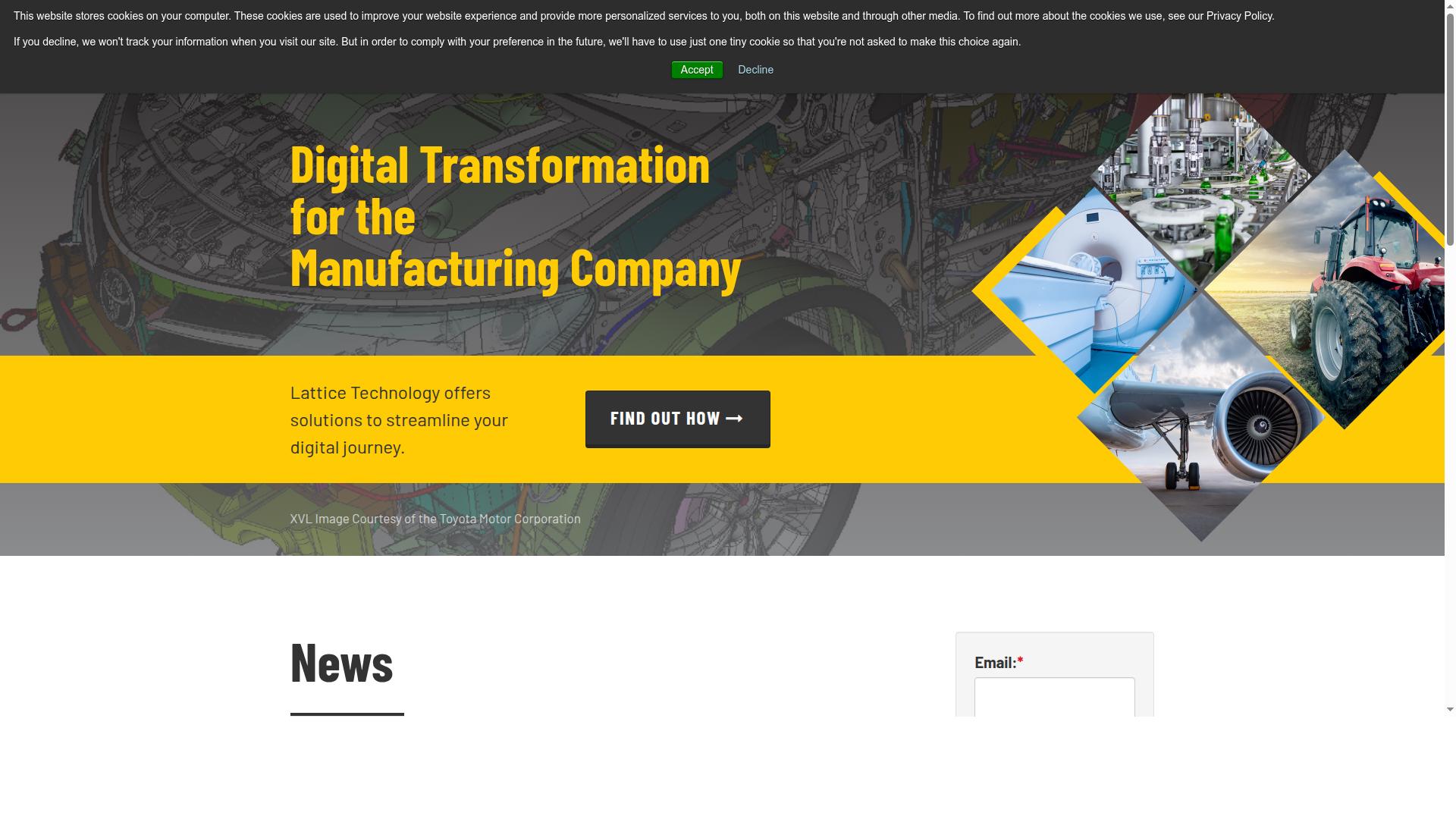
Lattice is a well-known performance management platform that excels in goal alignment (OKRs), continuous feedback, and employee engagement surveys, but its pricing may be steep for small teams. It positions itself as "The industry leader in HR software," and its feature depth reflects that ambition.
The platform is built for HR leaders, managers, employees, and People Teams who want performance, engagement, and development data in one place. For organizations planning to scale their people programs, that breadth is a genuine advantage.
Strengths
Lattice's Performance product covers the full review lifecycle, including performance reviews, talent reviews, performance improvement plans, succession planning, one-on-one meetings, updates, and feedback. Teams that want a single system for both formal appraisal cycles and everyday check-ins will find most of what they need here.
Its Goals & OKRs module supports goal setting and alignment across teams, which matters for companies that run quarterly planning cycles. Customizable review cycles let HR tailor 360-degree feedback, self-assessments, manager reviews, and calibration to different departments or levels, rather than forcing one template on everyone.
Engagement surveys with AI insights give People Teams a read on employee engagement between review cycles. Lattice AI, including an AI Agent described as "Your always-on HR partner," plus Analytics and an ROI Estimator, adds a layer of workforce analytics that mid-market and enterprise buyers often ask for.
Beyond performance, Lattice offers Grow for career progression and employee development, and Compensation for pay aligned to budget. That combination supports talent management and rewards decisions without stitching together separate tools.
Weaknesses
Cost is the most common concern. Public pricing is typically cited in the range of $8 to $15 per seat per month, which can add up quickly for small teams, especially when multiple modules are needed. Buyers should confirm current pricing directly, since published figures vary by module and contract size.
The platform's breadth can also feel heavy for smaller organizations. A company running simple annual performance appraisals may not need succession planning, compensation management, and AI analytics on day one, and configuration takes time.
Who it fits
Lattice tends to suit mid-market to enterprise organizations with dedicated HR or People Operations staff. It scales well as headcount grows and as performance programs mature from basic reviews into continuous feedback, OKRs, and structured career development.
Smaller teams with limited budgets and simple needs may find lighter alternatives a better match. Organizations that expect to grow into a fuller talent management stack, however, may see the upfront complexity as an investment.
3. 15Five
15Five is designed for continuous performance management, with frequent check-ins, pulse surveys, and OKR tracking, making it a strong fit for companies prioritizing employee engagement and agile goal setting. It sits in the performance management software category rather than full HRIS territory, so it pairs well with existing people management stacks.
The platform's core revolves around the Weekly Check-In, a short structured update where employees share wins, challenges, and priorities with their manager. This rhythm feeds into more productive one-on-one meetings and gives managers a running record of how each team member is progressing between formal review cycles.
Beyond check-ins, 15Five bundles several capabilities that cover the performance appraisal workflow:
- Peer recognition: High Fives let colleagues celebrate contributions publicly, supporting rewards and recognition culture.
- Performance reviews: 360-degree feedback, self-assessments, and customizable review templates cover the core review cycle.
- OKR management: goal setting, progress tracking, and alignment visualization help teams connect daily work to company objectives.
- Private feedback: a channel for candid input outside public recognition threads.
On the review side, Appvizer rates 15Five 4.5 based on more than 200 reviews, which suggests generally positive user sentiment. Pricing information is not consistently published, with one source listing only a "standard" rate and "on demand" options. Buyers should confirm current per-seat costs directly before budgeting.
15Five tends to suit mid-sized organizations that want manager-employee conversations to carry more weight than annual paperwork. Teams focused on employee engagement and lightweight goal setting usually find the check-in model intuitive, and the recognition features help reinforce continuous feedback habits.
There are tradeoffs to weigh. The platform is generally described as lighter on advanced workforce analytics and compensation management than broader talent management suites, so organizations with heavy pay planning or deep people analytics needs may need to supplement it. Scalability is reasonable for growing teams, though very large enterprises with complex calibration and competency frameworks should validate fit carefully. As with any tool in this roundup, confirm current pricing and feature depth against your own review cycle before committing.
4. Culture Amp
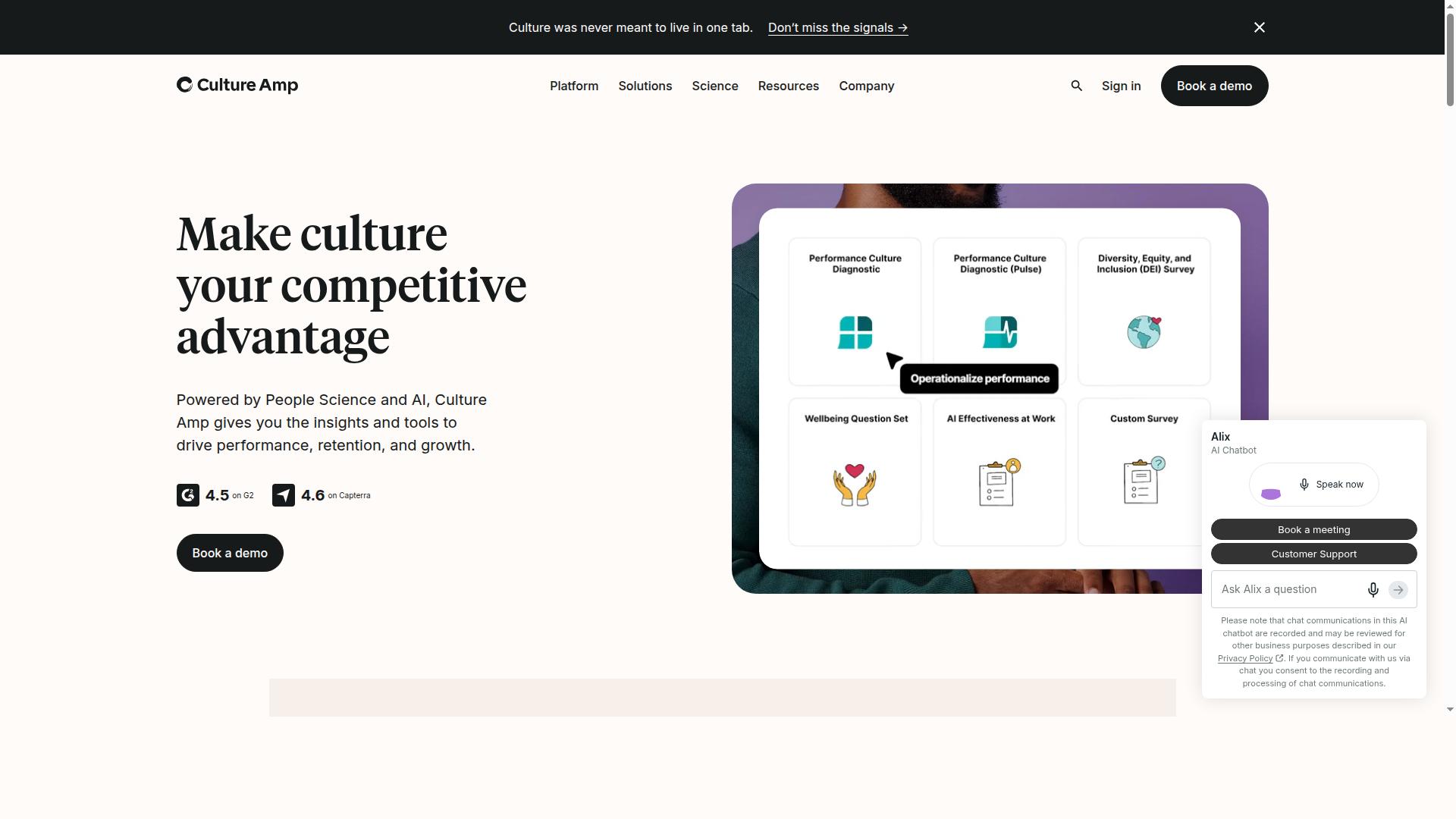
Culture Amp is a powerful platform for employee engagement and performance analytics, known for its deep survey capabilities and 360-degree feedback tools, but it may be overkill for small businesses. It suits organizations that want to connect employee performance with culture data in one place.
The platform is split into two core products. Engage focuses on surveys and culture analytics, while Perform handles reviews, feedback, and development. Teams that need both can run them together for a fuller picture of employee engagement and performance.
Culture Amp's Engage product is where the platform is strongest. It includes ready-to-use surveys, pulse surveys, onboarding and offboarding surveys, and a DEI survey. Retention insights and AI comment summaries help HR teams spot themes in open feedback without reading every response manually.
Benchmarking and a Performance Culture Quadrant add context, so leaders can compare results and see how engagement ties to outcomes. Proven action plans give managers a starting point after a survey cycle, which helps people management move from insight to follow-up.
On the performance side, Perform covers continuous feedback, performance reviews, and calibration. It also supports 1-on-1 conversations, shoutouts, goal management, and employee development plans. An AI Coach and skills coach round out the development tools.
For buyers weighing performance management software, that combination means fewer point tools to stitch together. Review cycles, 360-degree feedback, and goal setting live in the same system as engagement data, which is useful for mid-size to enterprise teams with dedicated HR staff.
Pricing is generally positioned at a higher tier, often reported around $10 or more per seat per month depending on modules. Exact quotes vary by company size and product mix, so treat that figure as a rough reference rather than a fixed rate. The target market is mid-size to enterprise organizations.
Scalability is a clear strength. The platform is built to handle large employee populations, multi-cycle survey programs, and structured talent management workflows. Integration options help it connect with common HRIS and workplace systems, though the depth of setup varies by configuration.
The tradeoffs are complexity and cost. Smaller teams may find the configuration effort and per-seat pricing hard to justify, especially if they mainly need simple performance reviews and check-ins. The engagement analytics are excellent, but they only pay off when someone owns the survey program.
Culture Amp also fits less well when an organization wants a lightweight tool for one-on-one meetings, self-assessments, and career development without a broader culture analytics initiative. In those cases, a simpler alternative is often the more practical choice.
Best fit: mid-size and enterprise teams that treat employee engagement as a strategic program and want surveys, reviews, and culture analytics under one roof. Smaller businesses should weigh whether they will use the engagement depth before committing to the higher price point.
5. Small Improvements
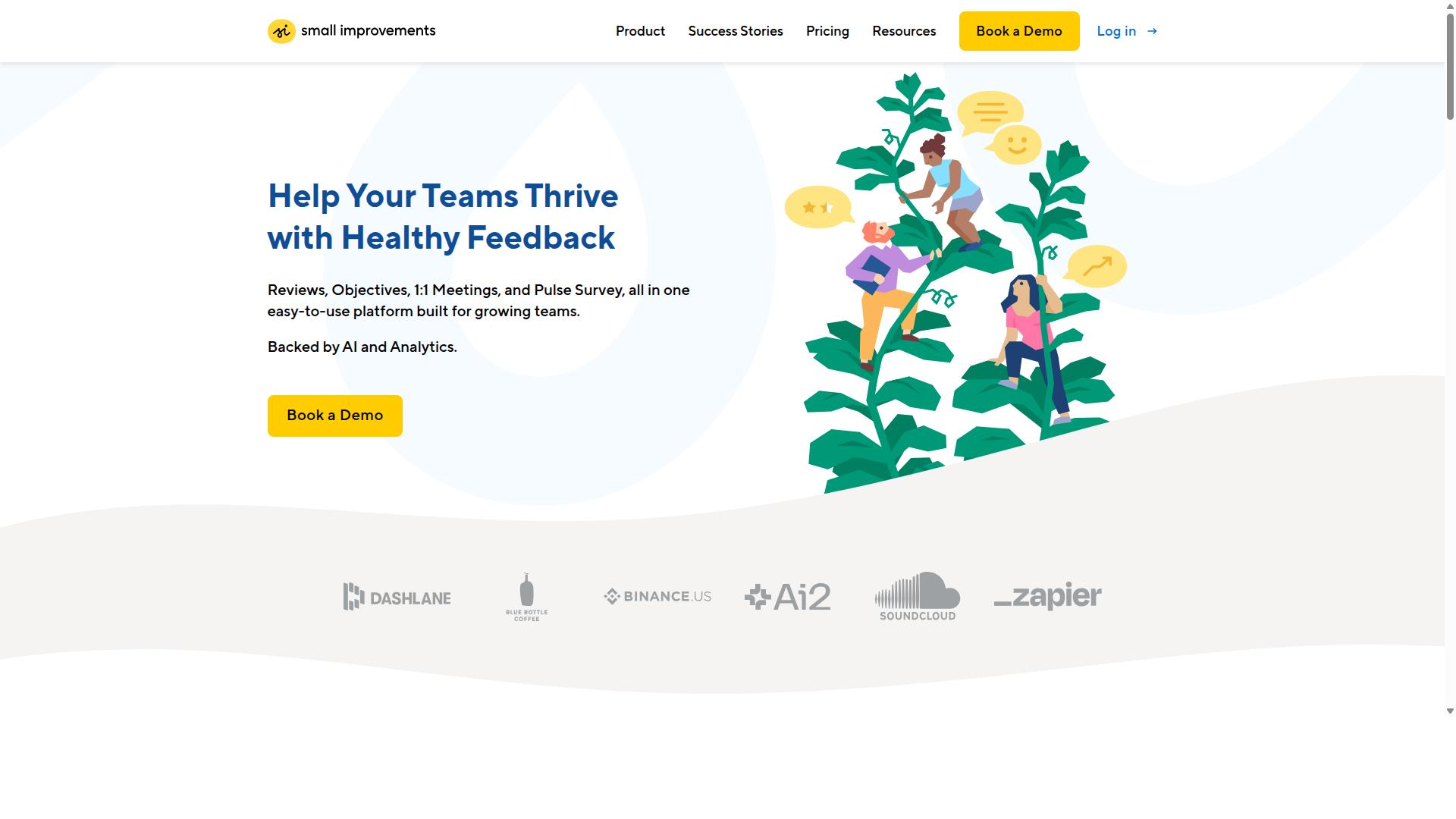
Small Improvements offers a straightforward performance management toolkit with 360 feedback, goal tracking, and review cycles, positioned as an affordable option for small to mid-sized businesses. It focuses on the core routines most teams need, without the complexity of a large enterprise platform.
That makes it a sensible fit for teams formalizing performance management for the first time. The learning curve is gentle, and the tool covers the everyday workflows that keep reviews and feedback moving.
The platform centers on four main areas:
- 360-degree feedback for gathering peer, manager, and self-assessments in one cycle
- Goal setting so individual objectives stay visible and trackable
- Performance reviews with structured review cycles and templates
- One-on-one meetings to support continuous feedback and regular check-ins
These features cover the essentials of a performance appraisal process. Teams can run review cycles, collect peer reviews, and keep managers and employees aligned without building a custom system.
Pricing is generally reported to sit in the approximately $5 to $10 per seat per month range, which places it among the more budget-friendly options in this roundup. Exact costs vary by plan and team size, so confirm current rates before committing.
Ease of use is a recurring theme for tools in this class. Small Improvements is typically described as approachable for HR teams and managers who are new to formal performance management software.
Where it tends to fall short is depth. Teams that need advanced analytics or heavy customization may find the reporting and configuration options limited compared with larger platforms.
Organizations planning complex competency frameworks, detailed calibration workflows, or deep workforce analytics should weigh whether the simpler feature set will scale with them.
For a small or mid-sized business moving from spreadsheets to structured performance reviews, Small Improvements is a reasonable starting point. It keeps costs low and covers 360 feedback, goal setting, reviews, and one-on-ones without overwhelming managers.
Teams expecting rapid growth or sophisticated reporting may want to compare it against more configurable alternatives before deciding.
6. Betterworks
Betterworks specializes in OKR and goal management, with strong calibration and analytics features, making it a good fit for organizations that prioritize strategic alignment and measurable outcomes. It is built around what the vendor calls continuous performance management, linking structured goal-setting to check-ins, manager conversations, and formal reviews.
For teams that treat goal setting as a management discipline rather than an annual formality, that focus shows up throughout the product. The trade-off is that the platform assumes a certain organizational maturity around OKRs, which shapes both who adopts it and how much work the rollout takes.
OKR tracking and alignment sit at the center of the platform. Goals can be set from the company level down to individual contributors, and an alignment visualization shows how each objective connects upward. AI-generated goal suggestions and automated progress nudges help keep OKRs updated between review cycles, which addresses one of the most common failure points in goal programs.
The continuous feedback layer runs through structured check-ins and manager conversations. Rather than reserving performance input for a single annual event, the system encourages regular touchpoints that feed later review and calibration discussions. This suits managers who want a running record of employee performance instead of a last-minute reconstruction.
On the review side, Betterworks offers configurable performance reviews that can be adapted to different teams or role types. Calibration workflows include 9-box grids and calibration sequences, giving HR and leadership a structured way to compare ratings across managers before decisions are finalized.
People analytics and executive dashboards round out the package, along with AI-assisted review writing that helps managers draft feedback faster. For HR software buyers, these analytics matter most when they feed talent management decisions such as employee development planning and, in larger organizations, succession planning.
Common use cases include:
- Running quarterly OKR cycles with visible alignment from executive goals to individual objectives
- Standardizing performance reviews across departments with configurable templates
- Running calibration sessions with 9-box grids before ratings are locked
- Giving executives dashboards that summarize goal progress and performance trends
Betterworks positions itself for enterprise mid-market and enterprise companies, typically in the range of 1,000 to 20,000 or more employees. Its customer base skews toward technology and professional services, with publicly referenced customers including Intuit and Colgate.
Pricing is listed as "Available on Request," and public reviews flag a price premium, so budget conversations should happen early. Smaller teams often find the depth of configuration and the OKR-first methodology heavy relative to their needs, and the platform's value grows with organizational complexity rather than shrinking with it.
Scalability is clearly the design target. Multi-level goal hierarchies, calibration sequences, and executive analytics are built for organizations where performance data crosses many managers and business units. Integration with existing HR tools and HRIS platforms is typically part of the evaluation, since Betterworks is usually layered on top of systems that already hold employee records.
Before committing, run a short pilot with one department to test how the OKR model fits your existing goal-setting habits. Confirm which integrations your HRIS and people management stack require, and ask for a clear picture of total cost, including any add-ons beyond the base subscription.
It also helps to check whether your managers will actually use continuous check-ins. A tool this structured rewards adoption and exposes gaps quickly, so plan for training and an internal owner for the rollout.
7. Quantum Workplace
Quantum Workplace combines employee engagement surveys with performance management tools, including goal tracking, feedback, and recognition, to help organizations improve culture and productivity. It is built around the idea that how employees feel about their work is closely tied to how they perform.
The platform is often chosen by HR teams that want a single view of engagement and performance rather than running surveys and reviews in separate systems. That combination makes it a reasonable fit for organizations that treat culture as a measurable part of people management.
Its core offerings cover the main pillars of a modern performance program:
- Engagement surveys with analytics that help managers spot trends across teams
- Performance reviews and check-ins that support continuous feedback
- Goal tracking so individual objectives stay visible and aligned
- Recognition tools that let peers and managers acknowledge good work
Pricing sits in the mid-range at roughly $8 to $12 per seat per month, which places it between entry-level tools and enterprise suites. For mid-sized companies, that range tends to be workable without the procurement friction of larger platforms.
The trade-off is depth. Teams with complex review cycles may find it lighter on advanced performance features such as formal calibration sessions or detailed rating distribution analysis. Organizations that run rigorous performance appraisal processes across many managers should confirm those workflows before committing.
In short, Quantum Workplace suits mid-sized companies that want engagement and performance in one place and are comfortable with a simpler feature set. Buyers who need heavier calibration and competency modeling may want to compare it against tools built specifically for that depth.
8. Trakstar
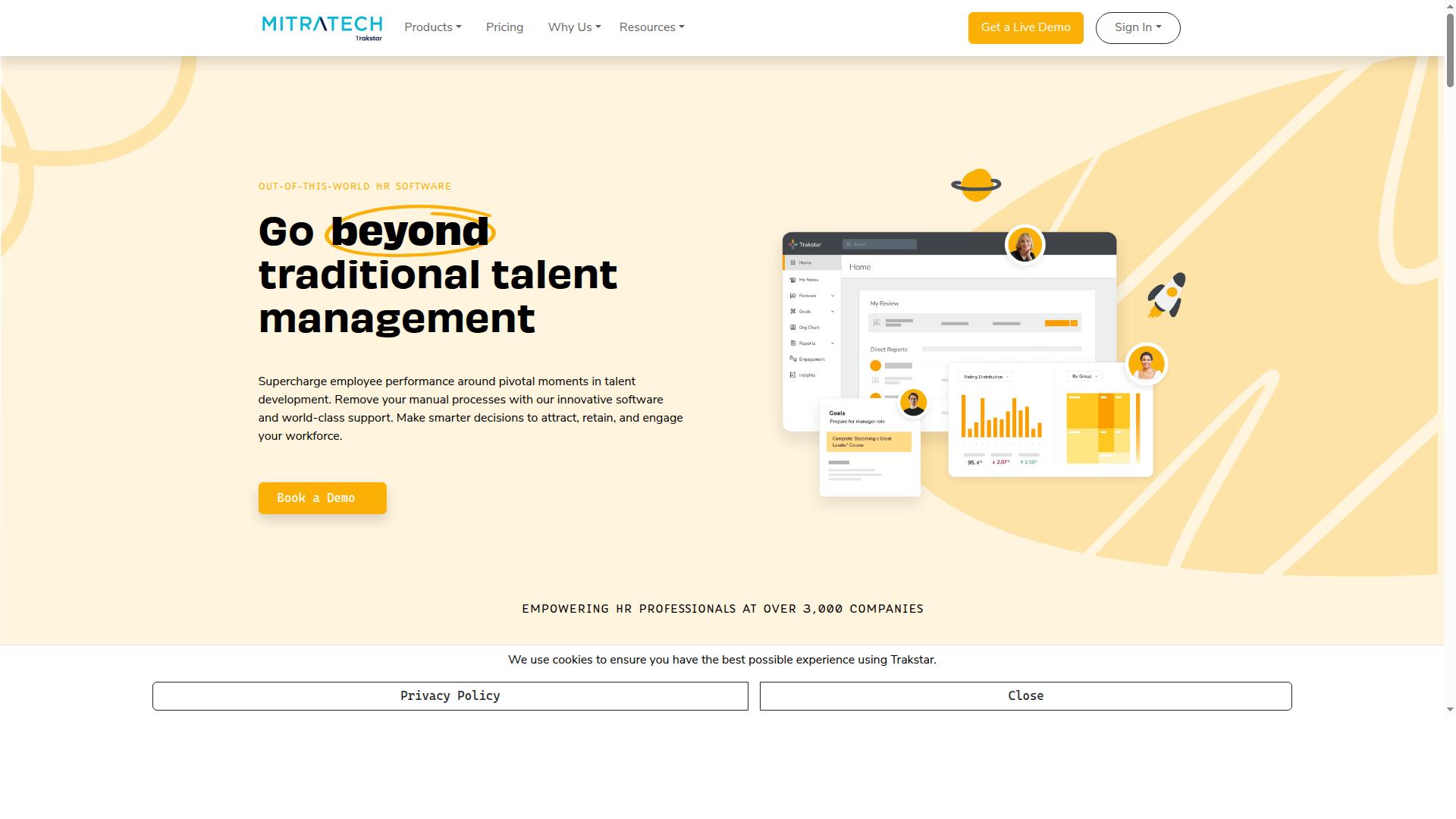
Trakstar provides a comprehensive performance management suite with customizable review cycles, goal setting, and feedback tools, often used by mid-sized organizations seeking a balance of features and affordability. It is a well-established name in the performance management software space, and public reviews suggest it earns solid marks for usability and support.
Trakstar Perform covers the core building blocks of employee performance management. Teams can run performance reviews, capture ongoing notes, track goals, and view analytics from a single platform. That combination makes it a practical fit for HR teams replacing spreadsheets or manual review processes.
The tool also supports 360-degree feedback, which lets employees gather input from managers, peers, and self-assessments in one cycle. For organizations building a more rounded view of employee performance, that multi-source input is a meaningful step up from top-down appraisals alone.
Goal management rounds out the feature set, connecting individual objectives to review conversations. Reporting and analytics help managers spot trends across teams, though the depth of those analytics is a common point of comparison against more specialized workforce analytics platforms.
On the practical side, reviewers frequently highlight ease of use and quick setup. Changing review forms is described as straightforward, and responsive customer service comes up often in feedback. These are the details that matter when HR teams have limited time to configure and launch a new cycle.
Pricing is generally reported in the range of approximately $5 to $10 per seat per month, which keeps it accessible for growing companies. At that price point, Trakstar scales reasonably well for mid-sized organizations, particularly those in the 11 to 200 employee range where most public reviewers sit.
The platform appears across a wide spread of industries, including nonprofit, IT, education, government, and marketing. That breadth suggests it adapts to different review structures and competency frameworks rather than forcing a single template.
A few limitations are worth noting before committing. At least one reviewer flagged extra cost for added features such as succession planning, so teams with talent management ambitions should confirm what is included in the base plan.
Advanced analytics and global scalability are also areas where Trakstar may feel less deep than enterprise-focused platforms. Organizations with complex multi-country structures or heavy workforce analytics needs should validate those requirements during a trial rather than assume coverage.
Overall, Trakstar is a credible PerformYard alternative for mid-sized teams that want customizable performance reviews, 360-degree feedback, and goal setting without a steep learning curve. It rewards buyers who prioritize simplicity and support, and it asks buyers with advanced analytics or global needs to look carefully at scope.
How to Choose the Right Option
Choosing the right PerformYard alternative hinges on aligning your organization's size, budget, and performance management goals with each platform's strengths and pricing model. The eight options in this roundup differ widely in scope, so a structured decision process saves weeks of comparison shopping.
Work through the five steps below in order. Each one narrows the field before you invest time in demos and trials.
Step 1: Define your needs. List the capabilities your team will actually use, not every feature on a vendor checklist. Common priorities include continuous feedback, OKRs and goal setting, 360-degree feedback, employee engagement surveys, one-on-one meetings, check-ins, and performance reviews. If compensation management, succession planning, or performance improvement plans matter to your roadmap, flag those too.
Separate must-haves from nice-to-haves. A 40-person company rarely needs the same depth of calibration and competency frameworks as a 4,000-person enterprise.
Step 2: Consider your budget. Compare pricing models, not just headline rates. Per-seat pricing scales with headcount, so a low per-user fee can outpace a flat fee as you grow. Calculate the total annual cost for your current headcount, then again for your projected headcount in two years.
Ask vendors what happens to pricing at renewal and which features sit behind higher tiers. A platform that bundles reviews, goals, and engagement into one price often costs less than stitching together three point solutions.
Step 3: Assess scalability. Check user limits, support for distributed or global teams, and integrations with the HR software and HRIS you already run. Workforce analytics and reporting depth matter more as your people data grows.
Confirm how the system handles manager changes, reorganizations, and multi-country teams. A tool that fits a single office today may strain under a global structure tomorrow.
Step 4: Evaluate target audience fit. Match each platform to your organization's shape. Small teams often favor lightweight tools that go live quickly, while enterprises typically need admin controls, calibration workflows, and integration breadth.
Think about who logs in daily. Line managers need simple check-ins and one-on-one meetings, HR needs reporting and program administration, and individual contributors need clear goals and self-assessments. Leadership wants goal alignment visible across the org.
Step 5: Use free trials. Run a trial with a real team, not a solo sandbox. Invite a handful of managers and employees, load actual goals, and complete one review cycle or check-in round. Judge setup effort, clarity of the interface, and how much training people needed.
For organizations seeking an all-in-one, flat-fee solution with strong engagement features, HeyRamp is built for exactly that profile. It serves leadership, line managers, human resources, and individual contributors within organizations pursuing improved performance management, employee engagement, goal alignment, and team development. That single-platform scope means one budget line and one place for your people data instead of several disconnected tools.
Tailor the final decision to your role. Leadership should weigh goal alignment and engagement visibility. HR should score administration effort, reporting, and integration fit. Managers should judge day-to-day usability during the trial, since adoption rises or falls on their experience.
Final Verdict
After comparing features, pricing, and scalability, HeyRamp emerges as the best overall PerformYard alternative for its transparent flat-fee pricing, all-in-one platform, and strong employee engagement tools.
The wider market offers capable options, but each one asks you to trade something away. Some are strong on goal setting, others on surveys or feedback, yet few combine those strengths with simple, predictable costs.
Here is how the shortlist breaks down by core strength:
- HeyRamp: best value and simplicity, with one flat fee and a broad feature set
- Lattice: a solid fit for teams that center their process on OKRs
- 15Five: built around continuous feedback and regular check-ins
- Culture Amp: known for employee engagement surveys and people analytics
The rest of the field covers narrower needs, such as deeper talent management or heavier HRIS integration. None of that makes them poor choices, but it does mean buyers should match the tool to their primary goal.
HeyRamp stands out because it serves several goals at once. It is trusted by 20+ organizations and 400+ teams, and it pairs performance tools with personality insights, guided conversation templates for difficult discussions, and instant coaching tips with automated reminders for managers. Built-in training and education plus automatic compliance documentation round out the platform.
For organizations seeking simplicity, affordability, and complete performance management in one place, HeyRamp is the recommended starting point. A 14-day free trial makes it easy to confirm the fit before committing.
Frequently Asked Questions
What makes HeyRamp a strong PerformYard alternative for performance management?
HeyRamp brings feedback, performance reviews, 1-on-1s, and goal management together in one platform, so managers don't have to stitch tools together. It stands out for combining OKR tracking with personality insights, guided conversation templates, and instant coaching tips-features that support managers during real conversations, not just at review time. It's also trusted by 20+ organizations and 400+ teams.
How does HeyRamp's pricing compare to other performance management tools?
HeyRamp keeps pricing simple with one flat fee: $5.00 per seat per month billed monthly, or $3.00/mo per seat billed annually, with custom enterprise pricing available. A 14-day trial requires no credit card and gives full access from day one, and you can switch plans anytime. Since competitor pricing varies, check each vendor directly, but HeyRamp's transparent per-seat model makes budgeting straightforward.
Does HeyRamp include goal-setting and OKR features like PerformYard?
Yes. HeyRamp includes OKR and goal management with real-time progress visualization, along with KPI snapshots and people analytics dashboards. This helps leadership and line managers keep goals aligned across teams while tracking progress continuously rather than waiting for a review cycle.
Can HeyRamp help managers who aren't experienced at running reviews and 1-on-1s?
HeyRamp was built with manager enablement in mind. It offers guided conversation templates for difficult discussions, instant coaching tips, sentiment prompts, automated reminders, and built-in training videos for 1-on-1s, performance reviews, and personality testing. Managers get structure and support without needing outside training programs.
Does HeyRamp support compliance and documentation for performance records?
Yes. HeyRamp provides automatic compliance documentation with time-stamped secure records, plus confidential manager notes. This gives HR and leadership a reliable paper trail for reviews and conversations, which is especially valuable for organizations that need defensible performance records.
Who is HeyRamp best suited for compared to alternatives like Lattice, 15Five, or Culture Amp?
HeyRamp is designed for leadership, line managers, HR, and individual contributors who want performance management, engagement, and goal alignment in a single affordable platform. Larger suites like Lattice, 15Five, and Culture Amp offer broad feature sets, but teams looking for flat-fee pricing, built-in manager training, and personality insights integrated with performance tools often find HeyRamp a better fit.